Why Choosing the Right Lifting Equipment Matters
Industrial lifting tools operate under conditions that would quickly destroy consumer-grade or light-duty alternatives. We are talking about repetitive heavy loads, extreme temperatures, corrosive environments, high-cycle operations, and scenarios where a single point of failure cannot be tolerated. Selecting equipment that matches these demands is not just about productivity — it is a fundamental component of workplace safety management and regulatory compliance.
In industries such as automotive manufacturing, steel processing, port logistics, and oil and gas, lifting and material handling equipment must meet strict standards set by bodies including OSHA, ASME, and EN standards in Europe. Beyond compliance, the right hoisting equipment reduces operator fatigue, shortens cycle times, and dramatically lowers the risk of product damage during handling.
Top Lifting Tools for Heavy-Duty Industrial Use
Not all lifting tools are created equal, and industrial applications demand precision-matched solutions. Here is a breakdown of the most effective options across key application categories:
Top Lifting Tools for Heavy-Duty Industrial Use
Industrial applications need lifting tools that’re just right for the job. Not all lifting tools are the same. Some are better than others for certain tasks. Here is a list of the useful lifting tools for different kinds of jobs:
1. Overhead Cranes (Bridge Cranes)
For places like steel mills, shipyards and car factories that need to move heavy things around overhead cranes are the best. They can lift things that weigh a lot from a tonnes to hundreds of tonnes and can move them around the whole workspace.
- Best for: They are best for lifting things over and over in factories and workshops.
- Key advantage: The good thing about them is that they can lift things without getting in the way of work.
- Semantic related terms: Overhead cranes are also called hoists, runway cranes, travelling cranes and workshop cranes.
Modern overhead cranes have controls that make them safer and more precise for lifting heavy things.
2. Chain Hoists and Wire Rope Hoists
When an overhead crane is not practical chain hoists and wire rope hoists are really useful. They can be attached to tracks or frames and can lift heavy things up and down.
- Chain hoists: Chain hoists are good for lifting things that weigh up to 20 tonnes. They are small and not too expensive.
- Wire rope hoists: Wire rope hoists are better for lifting things. They are strong. Can lift things quickly.
- Semantic related terms: Chain hoists and wire rope hoists are also called hoists, manual chain blocks, lever hoists, chain blocks and lifting hoists.
3. Hydraulic Jacks and Industrial Lifting Cylinders
When you need to lift something that’s really heavy and does not move, like a big machine, hydraulic jacks and cylinders are the best. They can lift things that weigh a few tonnes to thousands of tonnes. Toe jacks are really useful when you need to lift something in a space. Hollow plunger cylinders can lift things while a rod goes through the centre, which’s important for some jobs. Hydraulic jacks and cylinders are also called jacks, bottle jacks, floor jacks, hydraulic lifts and industrial jacks.
4. Forklifts and Reach Trucks
For places that need to move things around on pallets like warehouses and factories forklifts are really useful. They can lift things that weigh up to 48 tonnes. Can move them around easily. Heavy-duty forklifts can lift heavy things and are used in ports and other places where big things need to be moved. Reach trucks can lift things up high in spaces, which is useful in warehouses. Forklifts are also called trucks, lift trucks, warehouse forklifts, telehandlers and pallet handlers.
5. Gantry Cranes and Portable Lifting Frames
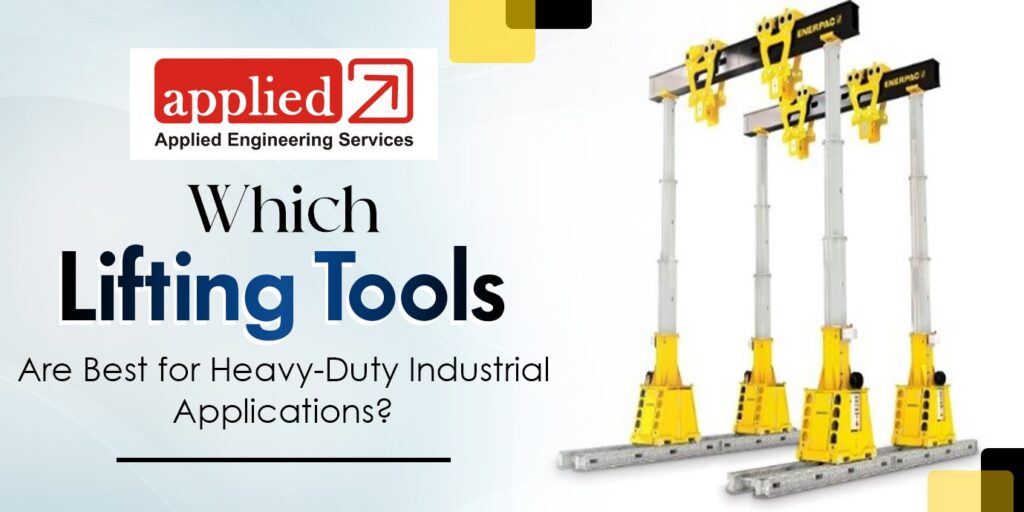
When you cannot install a crane gantry cranes are a good alternative. They can be fixed in one place. Moved around and can lift things that weigh several tonnes. Portable aluminium gantry cranes are light. Can be moved by two people but can still lift heavy things. Gantry cranes are useful in maintenance areas, loading bays and other places where things need to be lifted.
6. Rigging Equipment: Slings, Shackles, and Lifting Beams
Rigging equipment, like slings and shackles is important for lifting things. You need to choose the equipment for the job, based on the weight and shape of the thing you are lifting and the environment you are in. Rigging equipment includes wire rope slings, chain slings, webbing slings, shackles, lifting beams and spreader bars. Rigging equipment is also called rigging hardware lifting slings, wire rope slings, chain slings, spreader beams, shackles and lifting lugs.
Key Things to Think About When Choosing Heavy-Duty Lifting Tools
When you are choosing lifting tools there are a few things to think about:
✔ Duty Cycle: You need to make sure the tool can lift the weight of the thing you want to lift.
✔ Operating Environment: You need to think about how you will use the tool and choose one that can handle that amount of use.
✔ Operator Training: You need to think about the environment you will be using the tool in and choose one that’s suitable, for that environment.
✔ Regulatory Compliance: You need to make sure the tool meets all the safety standards.
✔Operator Training: You need to make sure the people using the tool are trained and know how to use it.
Industry Applications: Where These Lifting Tools Shine
Understanding which lifting tools best fit specific industries helps narrow the selection process significantly:
- Manufacturing & Packaging: Overhead cranes and electric chain hoists for production line lifting; gantry cranes and hydraulic jacks for maintenance tasks; rigging equipment throughout the facility.
- Construction & Infrastructure: Mobile cranes, tower cranes, and telehandlers for structural steel and precast concrete placement; chain hoists and hydraulic jacks for precision alignment.
- Mining & Quarrying: Heavy-duty wire rope hoists for shaft lifting; robust chain blocks for equipment maintenance; specialist hydraulic lifting systems for dragline and shovel maintenance.
- Oil & Gas & Petrochemical: ATEX-rated lifting tools for explosive environments; offshore cranes for platform equipment handling; hydraulic torque and lifting systems for pressure vessel and flange work.
- Warehousing & Logistics: Forklifts and reach trucks for palletised goods; dock levellers and loading equipment for truck and container loading.
Conclusion
Selecting the right lifting tools for heavy-duty industrial applications is not a decision to be taken lightly. From overhead bridge cranes and hydraulic jacks to wire rope hoists and precision rigging systems, each solution has a specific role to play in keeping industrial operations safe, productive, and compliant. The key is matching the tool’s rated capacity, duty cycle, and environmental specification to the demands of your application — and ensuring your team has the training to use it correctly.
Applied Engineering Solution is a trusted name in industrial equipment supply and engineering services, with deep expertise across material handling, lifting systems, and heavy-industry applications. With a comprehensive product range spanning cranes, hoists, hydraulic lifting equipment, and rigging hardware, Applied Engineering Solution supports manufacturing plants, construction firms, mining operations, and logistics facilities in selecting, sourcing, and deploying the right lifting tools for every application. Their team of experienced engineers and technical specialists provides not just equipment, but the end-to-end application knowledge to ensure every lifting solution is correctly specified, safely installed, and fully compliant with applicable standards.
FAQs
What is the most important safety factor when using heavy-duty lifting tools?
The single most critical safety factor is never exceeding the Safe Working Load (SWL) — also called the Working Load Limit (WLL) — of any lifting tool or rigging component. The SWL is the maximum load the equipment is rated to handle under normal operating conditions, and it already includes an engineering safety factor. Exceeding it removes that safety margin and risks catastrophic failure. Additional safety imperatives include ensuring all equipment is inspected and certified on the required schedule, that operators are formally trained and certified, and that all rigging configurations are checked by a qualified rigger before every lift.
How often should industrial lifting tools be inspected?
Inspection frequency depends on the equipment type, usage intensity, and applicable regulatory standards. As a general rule, all lifting tools should receive a pre-use visual check by the operator before each shift; a formal documented inspection by a competent person at regular intervals (typically monthly to quarterly depending on usage); and a thorough periodic examination by a qualified inspector at least every 12 months, or every 6 months for equipment used to lift people or in particularly demanding conditions. Records of all inspections must be kept and made available for regulatory review. Statutory requirements vary by country and industry — always consult the applicable standard for your jurisdiction.
What is the difference between a chain hoist and a wire rope hoist?
Both are types of industrial hoisting equipment, but they differ in construction, load capacity, and ideal application. A chain hoist uses a linked steel chain as its lifting medium, making it compact, durable, and well-suited for loads up to approximately 20 tonnes in environments where the lifting medium may be exposed to impacts or rough handling. A wire rope hoist uses a multi-strand steel cable wound on a drum, offering higher lifting speeds, greater capacity (up to and beyond 100 tonnes), and a finer level of load control at high speeds. Wire rope hoists are preferred for heavier applications, larger overhead crane systems, and where faster cycle times are required.
Can the same lifting tools be used in both indoor and outdoor environments?
Not always — and the distinction matters significantly for safety and equipment longevity. Equipment designed for indoor use may not have adequate corrosion protection, ingress protection (IP rating), or UV resistance for outdoor deployment. Similarly, outdoor or harsh-environment equipment may incorporate weatherproofing, stainless steel fasteners, and sealed electronics that add cost and weight unnecessary for controlled indoor environments. When selecting lifting tools for outdoor use — particularly in coastal, tropical, or chemically aggressive environments — always specify equipment with the appropriate IP rating, corrosion protection, and operating temperature range for your specific location and conditions.
What qualifications are required to operate heavy-duty lifting equipment?
Operator qualification requirements vary by country, equipment type, and the nature of the lift, but as a general principle, anyone operating heavy-duty lifting tools in a professional industrial context should hold formal certification or a demonstrable qualification relevant to the equipment. In most jurisdictions, overhead crane operators require formal training and certification; mobile crane operators must hold a specific crane operator licence; and riggers must be competent to a nationally recognised standard. Beyond the legal minimum, best practice includes regular refresher training, documented competency assessments, and a formal lift planning process for complex or critical lifts. Applied Engineering Solution can advise on training and competency requirements for specific lifting applications.